Lesson Structure
Lessons are conducted 4 days per week, Monday - Thursday. Each survival swim lesson is approximately 8-12 minutes in length and custom tailored to meet the physical, emotional and developmental readiness of each child. The duration of each lesson will be determined by the instructor and is based on a number of factors including age, ability, fatigue and physiological health.
Please Note: All lessons have a performance based exit and not a time based exit. No two children are exactly alike therefore; no two lessons are conducted exactly alike. A periodic maintenance schedule is recommended to preserve and strengthen skills as your child grows.
Please Note: All lessons have a performance based exit and not a time based exit. No two children are exactly alike therefore; no two lessons are conducted exactly alike. A periodic maintenance schedule is recommended to preserve and strengthen skills as your child grows.
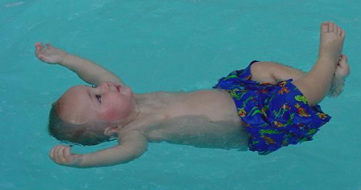
6 months - 14 months old: Roll to Float
|
Infants in this age group are taught the basic, yet essential survival skills of rotating from a face down position in the water to a face up position and independently maintain a comfortable floating posture. These life savings skills are also practiced while fully clothed for aquatic problem solving opportunities. These lessons are custom tailored to meet the physical, developmental and emotional needs of each child and are taught private with the instructor and your child. A child who enrolls in the SOS program as an infant will learn the correct posture for swimming early which will facilitate learning at the next level. The typical infant will approximately 4-5 weeks to attain these skills.
|
|
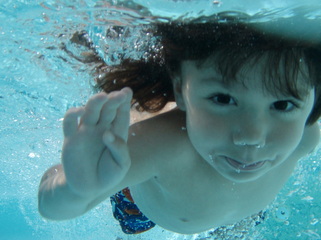
1 year - 6 years old: Swim Float Swim
|
Children in this age group are taught the basic survival skill of rolling back to float as well as independent swimming. Students will learn to hold their breath underwater, swim with their head down for approximately 3-5 seconds, when they are tired and need to breathe, they will independently rotate onto their backs, float, rest and when ready, the will flip over to resume swimming. They will repeat the swim, float, swim sequence as many times as needed until they can swim to safety. Upon completion of the course, your child will have learned the survival skills necessary to save himself from a potential drowning situation along with the enjoyment of recreational swimming. A maintenance schedule is recommended to preserve and strengthen skills as your child grows. This skill set can be achieved in approximately 4-6 weeks.
|
|
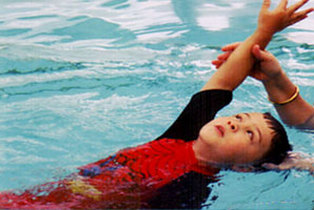
5 years & older: StrokesOnce swimming and floating skills are mastered, students can begin to learn the basics of backstroke form and freestyle swimming with a focus on refining their swimming strokes and proper propulsive kicking for a more streamline swim and breathing patterns. Regardless of age, students must acquire the basic survival skills (swim/float/swim) before moving into the Strokes course.
|
|
Refresher Lessons Infant growth in the first year...

As your child continues to grow their survival skills will need to grow with them.
Because children are always growing and learning new skills, your child’s abilities in the water will change from year to year -- and sometimes from month to month.
Remember that swimming is a sensori-motor skill. Similar to riding a bike or roller-skating, your child will not ‘forget’ what he or she learned. What often does happen is that he or she may outgrow the body that learned these skills. As your child grows their height and weight changes. Because of this, their center of balance changes as well.
WAITING...
We often hear parents say that they will just "wait and see how they do" each year. We strongly recommend against this. Often trying to work through the adjustments to their float unassisted can break down a child's confidence. This is exactly the opposite of your goals for them. It should only take a couple weeks to get them confident in their skills. Take the short time to get their boost their confidence. Enroll in refresher lessons early so you can enjoy the rest of the summer.
RETURNING ROLLBACK TO FLOAT STUDENTS
Infants should return the following year to learn the full Swim-Float-Swim sequence. They will need some adjustments to their float for the same growth reasons as the older children. But more than that, this is the fun year where they don't look like they should be able to swim and yet enjoy showing off and amazing every adult poolside. CALL TODAY to schedule your refresher lessons. We look forward to seeing how big each of our little swimmers has gotten.
Because children are always growing and learning new skills, your child’s abilities in the water will change from year to year -- and sometimes from month to month.
Remember that swimming is a sensori-motor skill. Similar to riding a bike or roller-skating, your child will not ‘forget’ what he or she learned. What often does happen is that he or she may outgrow the body that learned these skills. As your child grows their height and weight changes. Because of this, their center of balance changes as well.
WAITING...
We often hear parents say that they will just "wait and see how they do" each year. We strongly recommend against this. Often trying to work through the adjustments to their float unassisted can break down a child's confidence. This is exactly the opposite of your goals for them. It should only take a couple weeks to get them confident in their skills. Take the short time to get their boost their confidence. Enroll in refresher lessons early so you can enjoy the rest of the summer.
RETURNING ROLLBACK TO FLOAT STUDENTS
Infants should return the following year to learn the full Swim-Float-Swim sequence. They will need some adjustments to their float for the same growth reasons as the older children. But more than that, this is the fun year where they don't look like they should be able to swim and yet enjoy showing off and amazing every adult poolside. CALL TODAY to schedule your refresher lessons. We look forward to seeing how big each of our little swimmers has gotten.
